

In its 2025 edition, Chocoshow once again established itself as the most important event in the Colombian cocoa sector. A vibrant space that brings together producers, processors, entrepreneurs, academics, researchers, and consumers around a single protagonist: cocoa. Three full pavilions, a robust academic agenda, and live demonstrations allowed attendees to explore cocoa from all angles: its uses, its economic potential, its cultural role, and its growing impact on rural development in the country. But this edition added a special ingredient: the presence of the Clima-LoCa project, recognized in the region for its scientific and technical advances in cadmium mitigation, climate change, and the livelihoods of cocoa farmers in Latin America.
A meeting between science and territory
Clima-LoCa kicked off the academic agenda on Friday, November 28, with a discussion entitled “Challenges facing the Colombian cocoa sector: cadmium, climate change, and the livelihoods of cocoa farmers,” held in the Cacao Talks space at Corferias. Before the panel began, the project team proposed a participatory activity that invited attendees to reflect on three key questions:
- How is cadmium affecting the cocoa value chain?
- What challenges does climate change pose for production?
- How can we ensure decent and sustainable livelihoods for cocoa farmers?
Participants wrote their ideas on sticky notes and placed them at three themed stations. This activity allowed them to map out perceptions, concerns, and experiences that served as a starting point for dialogue. Based on these voices, Clima-LoCa presented findings from six years of research in Colombia, Peru, and Ecuador, which led to an in-depth debate on adaptation strategies, soils, markets, governance, and sustainability.
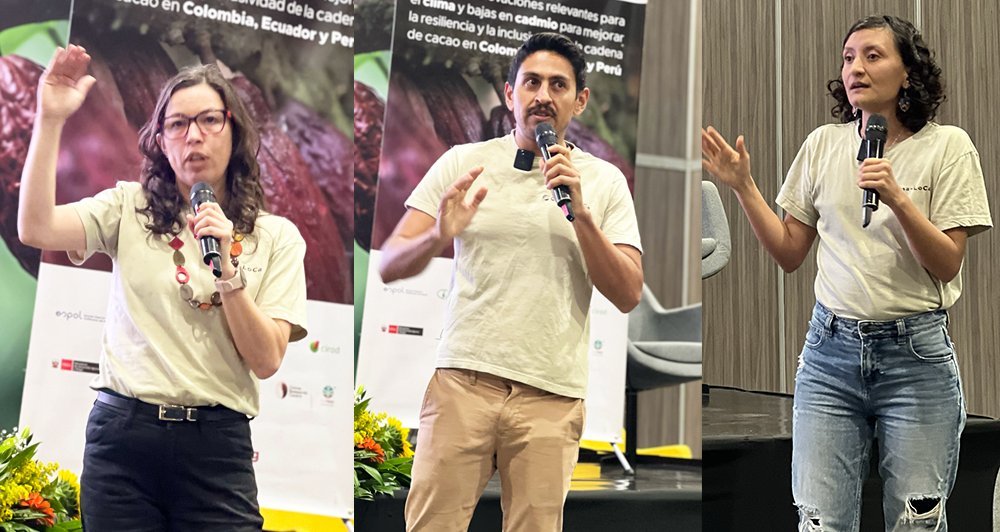
Mayesse Da Silva, Andrés Charry, and Mónica Chavarro are part of the technical and research team for the Clima-LoCa project, present at Chocoshow 2025. Photo: Camilo Beltrán.
“Coming from Baños de Agua Santa (Ecuador) to Colombia was a huge effort, but completely satisfying. We came to Chocoshow to learn, and what we received in the Clima-LoCa presentation was a real treasure.
Access to this information is not always easy for us, and here we were able to understand, with complete clarity, invaluable findings that we took away like gold to continue working on our crops and processes,” Pilar Medina, Fábrica Mágica de Chocolate, Baños de Agua Santa, Ecuador.
On Saturday, November 29, in the main auditorium of Corferias’ Academic Agenda, the project presented the conference “Comprehensive strategy for cadmium mitigation in Colombia: proposal and reflections based on the results of Clima-LoCa.” There, it shared recommendations based on scientific evidence that seek to strengthen the competitiveness of Colombian cocoa in the face of new international standards.
On this second day, the team presented the results and findings of years of research and delved into three key pillars of their research: plant genetics, soil condition and management, and territorial mapping carried out in different regions of the country. Attendees learned firsthand how certain cocoa varieties respond differently to cadmium, the importance of agricultural practices that improve the availability of the metal in the soil, and the results of spatial analyses that identified critical areas, accumulation patterns, and specific recommendations by territory.
Following this technical explanation, a valuable space was opened: the Cocoa Sector Experience Panel, where science intersected with the voices of those who are on the ground and work day in and day out in cocoa production and processing. Participants included Mary Casamaschín, an entrepreneur from Orito (Putumayo) and member of the Chocolate Route; Juan Fernando Gutiérrez, manager of Solidaridad’s Cacao and Carbon program; and Alejandro Zuluaga, management and innovation leader of Colcocoa’s Echar Pa’lante rural prosperity program. Mary Casamaschín shared how cacao has become a powerful tool for reimagining Putumayo:
“For years, we were seen as a department where nothing different could be grown, but we set ourselves a goal with cacao and tourism. We are convinced that Putumayo can be seen in a different light, and we are doing so with agrotourism and cacao processing. Many families want to invest in cacao, not only through the Chocolate Route but also through new initiatives. We have been a window for other families to learn, share knowledge, and for our department to be recognized as a cacao hub.”
For his part, Juan Fernando Gutiérrez highlighted the importance of recognizing, preserving, and promoting local knowledge:
“It is important to preserve knowledge of the territory. Every time I visit a farm, I am surprised. Some territories are beginning to specialize. We are not only talking about cocoa, but also chocolate making, confectionery, chocolate bars, and goods associated with the chain that will consolidate increasingly valuable local progress. Together, we must create an environment that makes this possible.”
Clima-LoCa provided clarity, tools, and hope at Chocoshow 2025 to a sector facing complex challenges, but also immense opportunities. The event left everyone with a shared certainty: the future of cacao is not built from a single place, but from the union of those who grow it, those who research it, and those who promote its value in global markets. The coming years will be decisive in transforming that future. With evidence in hand, with producers involved, with allies committed to the territory, and with projects such as Clima-LoCa, Colombian cacao now has more tools than ever to face its challenges and consolidate itself as one of the country’s major agricultural products. Chocoshow 2025 did not only celebrate cacao. It celebrated knowledge, collaboration, and the real possibility of changing the lives of thousands of cocoa-growing families.
Article written by: Camilo Beltrán